




Material reference
Quartz SiO₂
Chemically pure, optically clear, dimensionally stable. Fused quartz combines extreme hardness, low expansion and broad optical transmission from UV to IR.
Utilizado para: lab tubes & crucibles · investment-casting shrouds · glass-manufacturing rollers · semiconductor wafer carriers · UV/IR optics
At a glance
Key Properties
Very low thermal expansion
High chemical purity
Extensive optical transmission through light range
Excellent electrical insulation
High corrosion resistance
Suitable for high temperatures (up to 1100 degC)
Good thermal shock resistance
Can be manufactured to highly complex shapes
Products in this material
Quartz products
Mais detalhes
Este material não se limita aos produtos e aplicações ilustrados acima. Para mais informações, ou para conhecer outros produtos/aplicações, clique aqui.
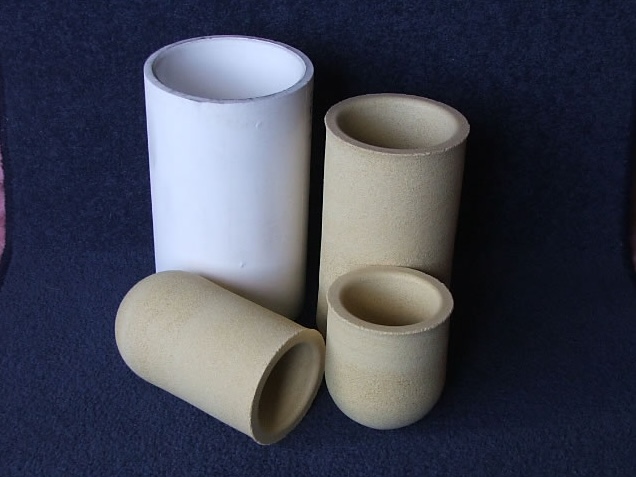
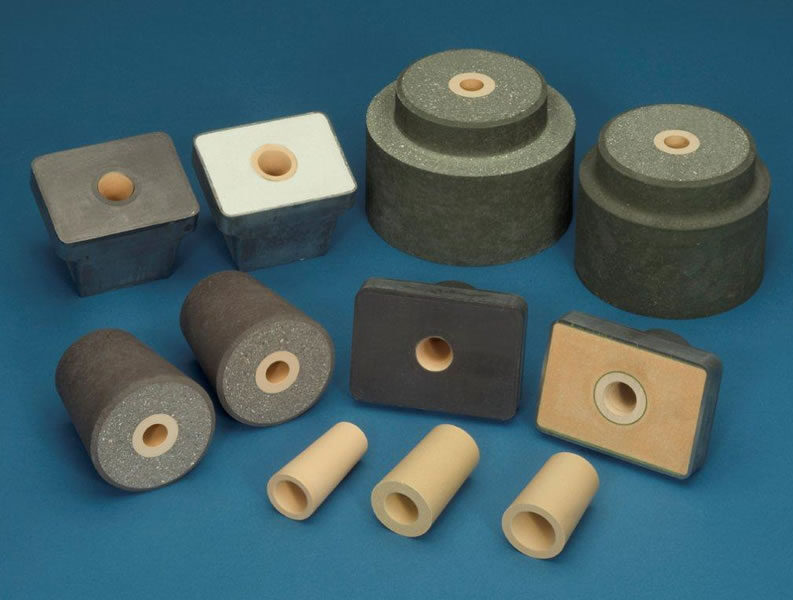
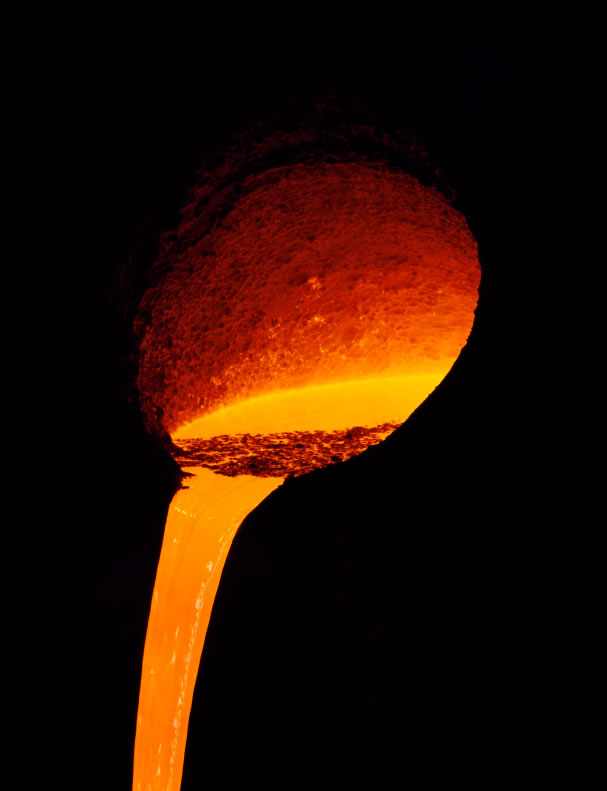
Quartz (Fused Quartz) as an industrial raw material is used to make various refractory shapes such as crucibles, trays, shrouds and rollers for several high temperature thermal processes including steelmaking, investment casting and glass manufacture. Refractory shapes made from Quartz have excellent thermal shock resistance and are chemically inert to most components and compounds including almost all acids, regardless of the application. Translucent fused silica (quartz) tubes are normally used to replace electric elements in room heaters, industrial furnaces and other similar applications.
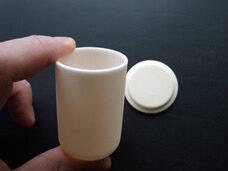
Our range of quartz products shows a very wide variety of possibilities, from small laboratory equipment to large wafer carriers or large diameter tubes.
Solicitar a ficha técnica de Quartz
Full property data, grade comparison, machining guidance and typical applications. EN and FR versions available.
At a glance
Application
Heat treatment tubes & chambers
Laboratory equipment
Capillary rods
Petro-chemical systems
Optical components
Semi-con manufacturing
Heating elements
At a glance
Grades of Quartz
Translucent QuartzOpaque QuartzHigh purity quartz grades
Considering alternatives?
Compare with related materials


FAQs
Frequent technical questions
What's the difference between quartz and fused silica?
Industrially, the terms are often used interchangeably. Strictly, natural quartz is crystalline SiO₂; fused quartz and fused silica are the amorphous glassy form produced by melting either natural quartz or synthetic silica. Anderman’s industrial quartz is the fused (vitreous) form.
Why does quartz devitrify?
At sustained temperatures above ~1100 °C, vitreous silica slowly converts back to crystalline cristobalite, becoming opaque and brittle. Keep continuous service below this point to maintain mechanical integrity.
Can quartz handle thermal shock?
Yes — the very low CTE (~0.55 × 10⁻⁶/K) means quartz tolerates rapid temperature changes that would crack most ceramics. Avoid prolonged service above 1100 °C to prevent devitrification.
Can quartz be made to complex shapes?
Yes, quartz can be manufactured using a number of different methods such as machining, welding, and laser cutting, meaning that very large, complex shapes can be assembled or very tight tolerances and complex geometries can be held.
Can you see through quartz?
Yes, translucent quartz is transparent and highly permittable for light from the UV range and Infrared range at high temperatures. This makes it suitable for high temperature applications where it is desired to see through the material body, such as test equipment and viewing platforms.
Nenhuma FAQ corresponde. Tente outra palavra-chave ou contacte-nos diretamente.
Contacte-nos
Need help choosing a grade? Talk to our materials team.
Tell us your operating temperature, the chemistry it'll see and any mechanical loads. We'll specify a grade — or recommend an alternative material — and link you directly to matching products.
- ISO 9001 certified
- Stock held in Kidderminster (UK) and Île-de-France (France)
- No minimum order value
Formulário de contacto
Diga-nos o que precisa
A member of the team will come back to you with a recommendation or a quote.